The most technically precise B3 emulation ever built.
Written in Rust. Measured from real hardware. The world's first Hammond B3 plugin with native CLAP and Linux support.
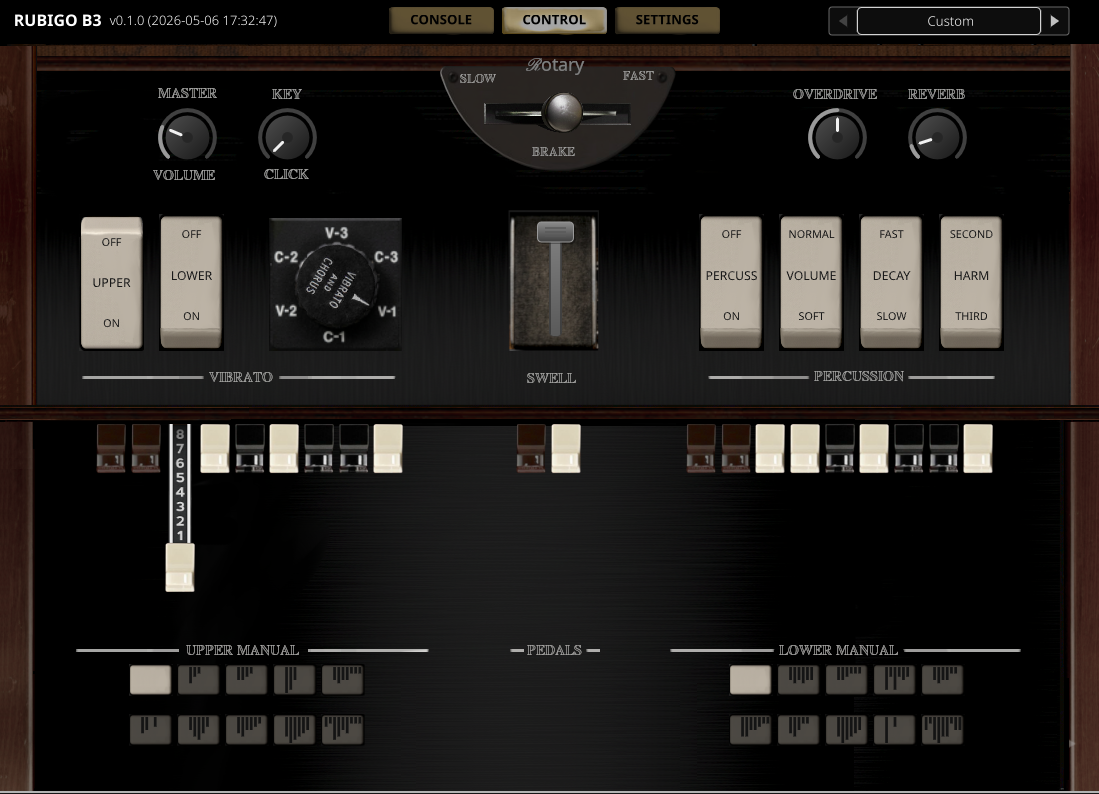
Written in Rust. Measured from real hardware. The world's first Hammond B3 plugin with native CLAP and Linux support.
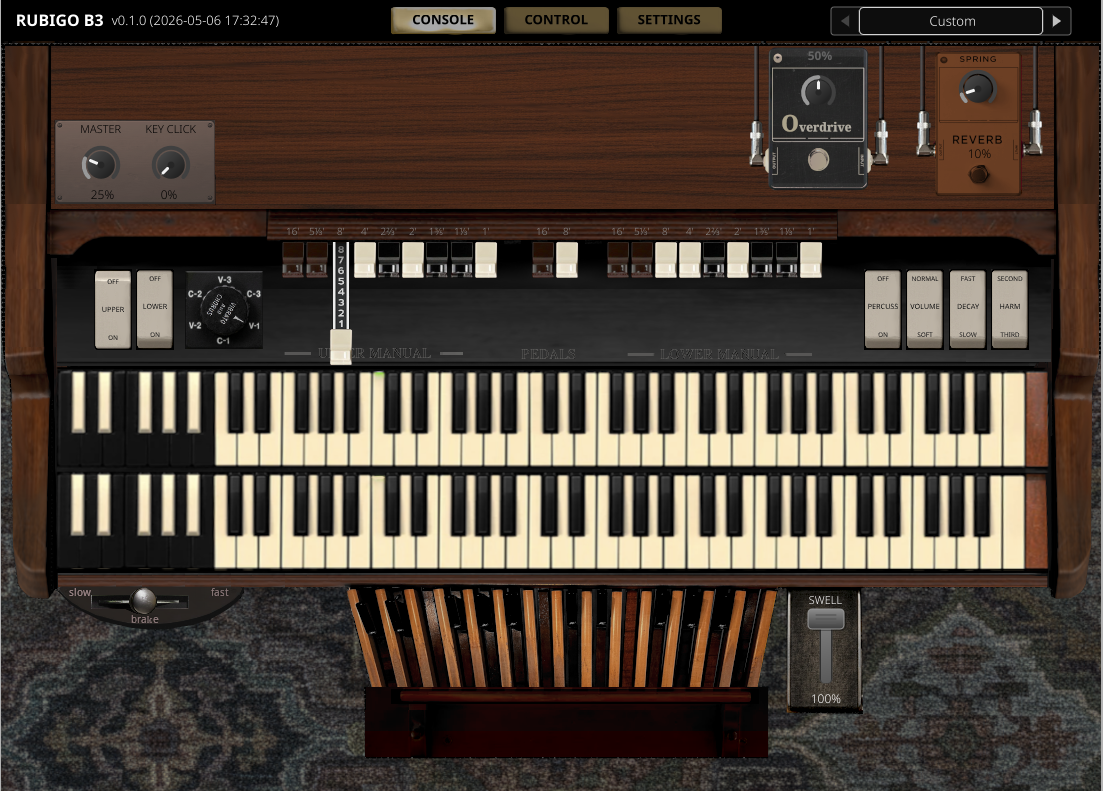
Most tonewheel plugins use theoretical algorithms or heavy 900MB sample libraries. We took a different approach. We measured the exact crosstalk matrix from real hardware to extract 6,552 individual leakage coefficients.
Combined with our 9-staggered-contact physical key click model, the result is an instrument that breathes exactly like the real thing, compiling down to a tiny 13MB binary.
Three genres. One engine. No samples.
Per-degree convolution. 360 IR slices. Absolute realism.
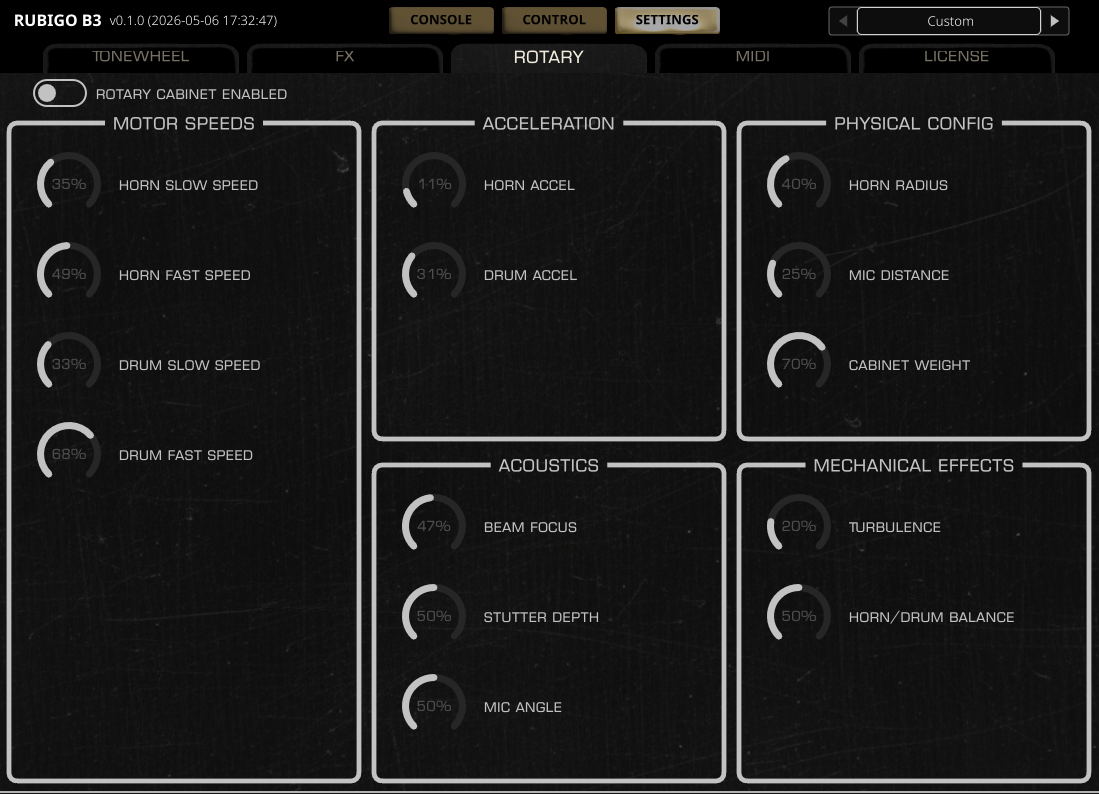
360 IR slices crossfade in real-time as the virtual rotor spins, synthesizing the exact Doppler effect and cabinet resonances of a spinning Leslie 122. No approximations.
Edit the physical geometry of the horn directly — radius, mic distance, and beam focus. The convolution IRs are synthesized from your parameters on load, not baked in.
Independent horn and drum acceleration curves. Dynamic wind turbulence and mechanical noise that emerges naturally from the rotation speed, just like the real cabinet.
Powered by our CatLSTM engine trained on real AO28 preamps. Zero generic saturation. Zero CPU bloat.
The AO28 preamp overdrive isn't a generic saturator. It's a conditioned LSTM neural network, trained on real hardware measurements, compiled directly into the Rust binary with AVX2 SIMD — so it uses almost zero CPU.